



How to choose the right open-mouth bag for industrial bagging ?

Key points
- 1. Material: The product’s primary protection
- 2. Structure
- 3. Closure
- 4. Standards and options: Hygiene, safety and traceability
Introduction
In the world of industrial production, packaging is not a minor detail, it is a strategic step. The choice of bag has a direct impact on the protection of your product, the efficiency of your production line and the safety of your operators.
Résumez cet article avec une IA
Here we will provide you with a clear and expert summary of everything you need to know about making the best decision for your specific needs.
What is an open-mouth bag (OMB)?
An open-mouth bag (or OMB) is a preformed packaging manufactured in a factory and delivered ready for use. Unlike FFS (Form-Fill-Seal) systems, which form the bag from a reel, the OBB is simply fed into a bagging machine which picks it up, opens it, fills it and then closes it.
Its main advantage lies in its incredible versatility. It can be adapted to a wide range of products (powders, granules, parts), materials (paper, plastic) and closure systems, making it an essential standard in the food industry, chemical industry, animal nutrition and construction materials sectors.
The 4 key criteria for selecting the perfect bag
There is no such thing as the “best bag“. There is only the most suitable bag for your product, your environment and your constraints. Here are the four essential points to consider.
01.
The material: the first line of protection for the product
The choice of material depends on the nature of your product and its storage requirements.
Kraft paper
Often composed of several plies (2 to 4) for increased strength, it is valued for its robustness, its natural appearance and its breathability, ideal for products requiring air evacuation (cement, plaster). It is also perceived as a more environmentally friendly solution.
Plastic (polyethylene PE or polypropylene PP)
Its main strength is its waterproofing. It provides a perfect barrier against moisture, oxygen and fats, which is crucial for bagging food products, chemicals or pet food. It guarantees optimal preservation and prevents clumping.
Composites (paper + PE lining)
The perfect compromise. These bags combine the rigidity and aesthetics of paper with the protection and food safety of a PE liner. This lining, either loose or laminated, ensures no cross-contamination, an essential criterion in the pharmaceutical and agri-food sectors.
02.
The structure
Flat-bottom/square-bottom bags
Flat-bottom or square-bottom bags offer perfect stability when filled. They stand upright on their own, which is an advantage for point-of-sale presentation but above all for stable and secure palletising.
Gusseted bags
Gusseted bags are the most common type. Their side gussets allow the bag to take on a rectangular shape when filled, thus optimising the useful volume.
03.
Closure
The closure system must be chosen according to the level of security, watertightness and cleanliness required.
Stitching
A quick and economical method. A paper tape can be added to improve the finish and cleanliness of the packaging.
Welding (heat sealing)
Ensures an airtight seal, ideal for preserving products sensitive to moisture and guaranteeing impeccable hygiene.
Gluing or pinching (Pinch Top)
A very clean and secure method: the top of the pre-glued bag is folded over and then heat sealed, providing a sturdy and attractive closure.
Did you know?
Choosing the right bag is the first step. But to ensure maximum productivity and reliability, it must be perfectly suited to your filling equipment.
HALPAQ offers a complete range of machines to efficiently fill and close all types of bags, while respecting the integrity of your product and the constraints of your sector.
Overview of Solutions on the Market
| Priority need | Recommended solution | Typical areas of application |
|---|---|---|
| Breathability & Ecology | Multi-ply Kraft bag | Cement, mortar, flour, seeds |
| Waterproofing & Preservation | PE or PP bag | Fertilisers, polymers, pet food, sugar |
| Hygiene & Food Safety Max | Kraft bag with PE lining | Powdered milk, pharmaceutical ingredients |
| Stability on pallet | Square bottom bag | Animal feed, retail products |
| Absolute cleanliness | Pinch Top Bag | High-value food and chemical products |
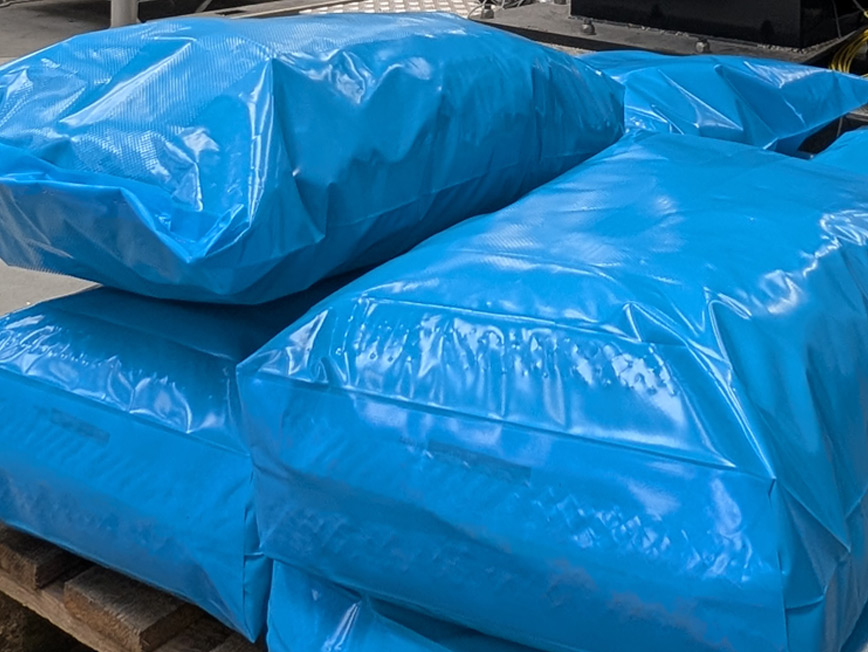
Standards and options: hygiene, safety and traceability
Food compliance
Use of materials and certified printing inks for food contact, ensuring maximum safety.
Barrier properties
Option to add UV protection for light-sensitive products or anti-static treatment for fine powders.
Easy to open
Presence of tear strips allowing easy opening for the end consumer.
Degassing valves
Essential for products such as coffee that release gases after packaging, ensuring the stability of the bag and the quality of the product.
Conclusion: a strategic choice for your production line
The choice of an open-mouth bag goes far beyond the concept of packaging. It is a technical decision that directly influences product quality, supply chain security and production efficiency.
By analysing your needs using four key criteria — material, structure, closure and standards — you will be able to communicate effectively with manufacturers and select the optimal solution.
Discover our guide now: